By Matthew Head
Note: This article was originally published on the dyslexia.com website. We’re sharing it here for our community.
After reading the book The Gift of Dyslexia (see my review here), I felt the overwhelming need to get myself on a Davis® Mastery for Dyslexia program.
I looked up my local facilitator, Tessa Halliwell. I dropped her an email that morning to enquire about the program, and by that evening we had a short introductory Zoom call.
I remember feeling quite emotional after this as I had the very strong feeling that this program would really assist me in areas that I had believed could not be corrected but only mitigated.Note: This article was originally published on the Ron Davis Autism Foundation website. We’re sharing it here for our community.
I think the feeling of mixed emotions was a combination of excitement to see where this process would take me, and the difficulty of letting go of a belief that my brain, although wonderful in some aspects, really couldn’t do some other things.
I have always believed that I have a lot of positive attributes to bring, quite a few of them shaped by my dyslexia. However, this is balanced by some weaker skills. All my life I’ve been unable to spell very well, having to use all sorts of tricks to get round this issue (dyslexialifehacks.com), but it always creeps through.
Due to participating in this program in January 2021 when the UK was still under Covid-19 pandemic restrictions, the program was carried out in its entirety over Zoom (Video Calls). A little bit housekeeping from myself before starting was required: I made sure my Webcam was in good order and borrowed a set of laptop speakers, so I didn’t have to sit with a headset on for hours each day, and then I was good to go. To anybody reading this in the future – welcome to what life was like in 2020/2021! An initial concern for me was that doing the program over Zoom might be an issue; however, this was soon eliminated after my first initial assessment with Tessa.
The initial assessment is a simple exercise to check my perception ability also the added bonus of visualising a very nice chocolate orange cake, yummy! As it would have it, I have quite a strong perception ability, which allows me to be suitable for orientation counselling.
A note on this article: This outlines my experience of the program and touches on some of the techniques used. It is not to be taken as a guide to the techniques or how to use them. For this, I recommend reading the book The Gift of Dyslexia and/or booking yourself on a Davis® Mastery for Dyslexia program.

With my kit in hand – plasticine (modelling clay), modelling tools, a workbook, the course manual, Koosh Balls, and a dictionary – I was ready to start. My conditioned brain had learned to shudder at the sight of the dictionary; however, during the program it would become a surprising ally.
The first day consists of carrying out the orientation procedure, so I have control of my mind’s eye. This enables me to better understand when I’m being disorientated. Because of the remote setting, this involved getting creative with blue tack and making sure my webcam was parked in the right place; after that, the procedure was straightforward. I admired Tessa’s ingenuity in getting round the video call limitations. While doing this course over Zoom I found it very useful to have a USB webcam rather than using a laptop’s integrated camera.
With this new tool in hand, it was now onto the alphabet. “ABCD EFG HIJK LMNOP…” is the song that sings in my head every time I must think of the order of letters. By the evening of 18 January 2021 that song was pretty much redundant!
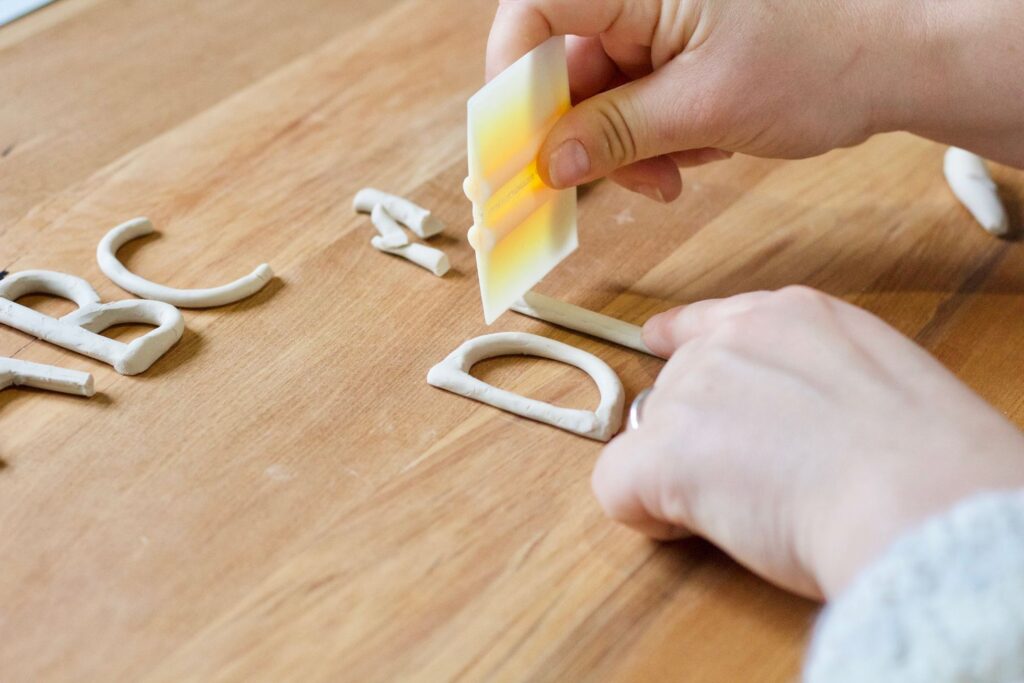
The alphabet mastery programme consists of first modelling all the uppercase letters using plasticine in a type font set out by the programme. After an initial go at modelling the letters, it was clear that my alphabet needed work. My ABC was a nice, consistent size and it slowly grew. The first thing was to remodel all the letters so they were consistent size and height, then the fun part begins.
I then got “on point” and looked over all 26 letters. Then I was assessed on the alphabet layout. This involved picking letters at random and me trying to tell which letters went before and after it in the sequence. If there were troublesome letters, Tessa would go through a procedure with me to see if there was any kind of attachment to these letters that might be triggering my mind’s eye to move.
This is one of the driving principles of Davis® Mastery for Dyslexia: putting your mind’s eye on its orientation point so that external reality is the reality your eyes see, then developing an understanding of when it might have shifted off this point. This would happen to me when I was confronted by a trigger letter.
Throughout the afternoon the magic of this program really came to life. Once we had cleared the alphabet of any triggers and checked a few times that I had mastered it, it was done! No need to come back the next day or week and do it again and again. Mastering the alphabet isn’t tricky once the conditions are set correctly. I got to the point where I could be asked about any letter in the sequence and have no problem with it. This was repeated with the lowercase alphabet.
My brain now has clear pictures for both upper and lowercase alphabet. This also cleaned up some letter confusion, including flipping Bs and Ds round, or Ps and Qs. Post-program, although I never thought I had visual stress, letters of any type font or colour now stand out strongly and clearly to me.
The same technique applied to punctuation. I thought I knew what punctuation meant, but now I know with certainty. I found an instant improvement in how I looked at punctuation on a page and my comfort with it, which then helps with reading and writing.
Tessa introduced various building blocks throughout the program to assist with the written word:
Part of the non-literary side of the program, which really surprised me, was integrating being “on point” with my balance and hearing. Before starting, I had an idea that being dyslexic might throw my kinesthetic ability off slightly. I never thought it had any effect on my hearing.
The balance exercise involves being orientated and standing on one leg and moving my mind’s eye around until I find a point where I’m perfectly balanced. Wow! Suddenly I am super balanced and barely have to do any muscle control of my legs.
The formal exercise to check this is using Koosh Balls to play catch. The benefit of these balls is that they don’t bounce very much so it’s fairly easy to catch. It feels like I suddenly gain a superhuman ability to catch these balls while still on one leg, as long as I stay “on point”. The moment I drift off point is the moment I drop a ball or lose my balance.
Now to the part which really, really surprised me: I am able to move my hearing along with my mind’s eye. I’ve always been aware of being able to mentally conjure up pictures and play through scenarios, seeing things in 3-D in my head is easy for me. What I had not been aware of until now is that I’m able to move my hearing around. I just assumed everybody could move their hearing into a conversation next to them and listen as if sitting there, but clearly it’s a dyslexia talent again.
The ability to orientate my hearing involved playing sound through sets of headphones. I spent a long time convinced something was coming into my right ear, which turns out to be my dominant ear. Once I had completed the exercise with Tessa’s coaching, I was able to get the sound to come out where my mind’s eye is, and everything felt nicely in calibration. That very evening while watching the TV, I became aware of how it sounds different and my improved ability to listen to someone having a conversation with me and, more importantly, noticing when my hearing is drifting off somewhere else.
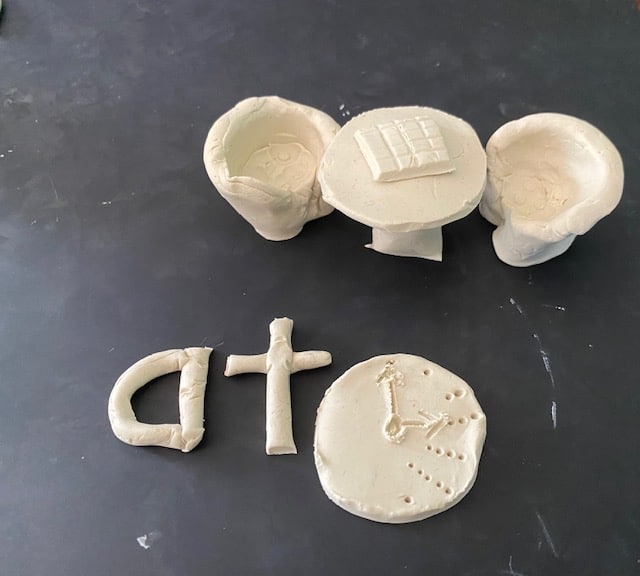
After ensuring I was able to orientate, we moved onto “Symbol mastery”, which is probably the core of Davis® Mastery for Dyslexia. Like “Alphabet Mastery”, this involves using plasticine, but this time to model up the meaning of words.
I started off by modelling meanings for parts of the English language, for example: adjective, verb, and preposition. These parts of language have always felt like abstract concepts to me. I had to learn them to pass my English GCSE when I was at school, not really grasping what they actually mean and how they are used. Now, having modelled these words in plasticine and then going through the Davis mastering process I am comfortable with the meaning of these words and how they are structured in language.
I have been statemented with dyslexia from about 6 years old. I have created a website Dyslexia Life Hacks, this shares the various tools and techniques I have developed over the years to make life easier, and is a safe space for you to share your thoughts and suggestions for further hacks!
Another remarkable part of this process is that spelling also gets mastered. As part of the learning process, I modelled “preposition” twice. The second time I had a better understanding of how to make a model that made sense to me and what it felt like to have it fully mastered. Once I had mastered preposition – a complicated word – I became confident in the spelling of it, not even having to second-guess myself.
We then moved on to tackling my trigger words. Put simply, these are words I do not have a mental picture for, so as I read them I get a blank. For me, this is where symbol mastery gets challenging but also rewarding.
The trigger words I selected to master with Tessa’s help initially were: “the”, “a”, “from”, and “their”. Trying to model the meaning of a word when you have a complete blank mental picture is really tough. This is where the modelling comes into its own. After looking the definition up in various dictionary resources, I would start with an initial part of a model to see how it felt to me.
This was hard. Having a complete blank and trying to conjure up something in plasticine takes a lot of trial and error. I would initially start one idea and I just get the feeling that the model isn’t really talking the definition to me. Tessa would provide guidance and prompts to get me thinking about what I wanted from the model and I would try something else. This would be an improvement but it might not feel right. I remember sitting for ages looking at “their”, feeling quite frustrated that I could not show a sense of ownership in the model. A few more iterations on and I got a model I was happy with. Then it was a case of writing out the word underneath the model with clay letters from my alphabet and carrying out the mastering process.
Sometimes the modelling can take nearly an hour to get to a point where, without even looking at the dictionary or any other prompts, I can use just a model in my mind to know the meaning. It would just be feeling inside like, “that’s it – that’s the model that makes sense”.
The mastering process takes a matter of 2 to 3 minutes and this still amazes me. The gift of mastery truly is a gift.
Spelling has always been a particularly weak point of mine; however, using the techniques laid out in Davis® Mastery for Dyslexia, I am well on the path to eradicating this weakness. Symbol mastery is used to understand the definition and get the spelling of words when I do not necessarily know the definition.
For words that I already have a strong definition/mental picture of and cannot spell, there is an alternative technique. This involves eradicating old incorrect spellings, getting orientated, and spelling the word correctly to myself forward and backwards and then mastering it – the gift of mastery paving the way once again! It’s that straightforward.
Now that I have completed the program, the true hard work really starts. I need to complete the 250 trigger words with symbol mastery to truly have my dyslexia corrected. I am highly motivated and driven to complete this part. I already feel a change within myself and my outlook.
Removing some of the self-limiting beliefs, misinformation, negative self-talk, and old solutions has massively grown my confidence in my ability to not only learn the English language, which is a beast I now feel more comfortable with, but also to learn other things, for example, playing the guitar or teaching myself basic piano.
With the removal of the voice that nags in the back of my head saying “you are rubbish at learning things” I have been able to replace it with one that says, “you have a gift that allows you to master things very quickly”. Having the tools to understand when I am disorientated, therefore enabling me to get back “on point” if needed, is already paying off in day-to-day life.
I would urge anybody who is dyslexic or knows somebody with dyslexia to use this program to enrich their life. It is well worth the money invested in it and will pay off for years to come.

Find a Davis Facilitator near you or contact us to discuss your options.