
Can you child remember every dinosaur species? Build working robots? Or tell you the most vivid, imaginative stories? But can’t remember what comes after the letter M? This article is for you.
In an online parent forum recently, a mum posted that her 4th-grade son couldn’t reliably sing the alphabet. Different gaps each time, different errors on different runs. She described feeling helpless. He had a tutor. He worked hard. The evenings were consumed by homework he couldn’t finish. And still, the alphabet didn’t stick.
The thread drew hundreds of responses. Parents sharing versions of the same story: children who know their letter sounds but can’t sequence them. Kids who sit at the top of the maths class but can’t recite the days of the week. Children being sent home with more rote practice, yet that’s the one thing that keeps not working.
If that’s your household, here’s what you need to hear: this is not a memory problem in the conventional sense. And that difference matters, because treating it like one is why the standard approaches keep missing the mark.

The alphabet is what’s called an arbitrary sequence, a fixed order with no underlying logic. There’s no reason D follows C other than convention, vowels are mixed with consonants and most frequently used letters are not grouped together. The same is true for days of the week, months of the year, and times tables. You can’t reason your way through an arbitrary sequence. You have to hold it as a whole, intact, in working memory.
For neurotypical children, repetition builds that whole automatically. For many neurodivergent brains, repetition without understanding doesn’t anchor, because there’s nothing to understand. The sequence is meaningless, so it doesn’t stick the way meaningful information does. More practice doesn’t fix this. It just means more practice at the thing that isn’t working.
This shows up across sequential tasks: days of the week, months of the year, telling time, following multi-step instructions. It’s the same underlying challenge presented in different places. And it’s one of the most commonly missed aspects of dyslexia and ADHD assessments, because it doesn’t look like a reading problem until you understand what’s behind it.
Davis facilitators describe this through the lens of disorientation: when a dyslexic or ADHD mind encounters confusion or overwhelm, like the confusion of a meaningless sequence, it responds by generating its own mental impressions to compensate. The child isn’t forgetting the alphabet. Their brain is doing exactly what it’s wired to do. The problem is that conventional teaching assumes a neurotypical brain will just absorb arbitrary sequences through exposure. For many kids, that’s simply not how their minds work.
“Ron Davis could not learn the alphabet in order until he was an adult. When he figured out why, he designed programs specifically to fill in the conceptual gaps for others like him.”
Davis founded his first centre in 1982 after overcoming his own severe dyslexia at age 38. He was autistic, had been unable to read until adulthood, and had built an engineering career entirely around compensating for what school had failed to teach him. The alphabet, for Ron, wasn’t a minor gap. It was a symbol of everything that arbitrary-sequence learning demands from a brain wired for picture thinking.
One of the core components of the Davis Attention and Dyslexia programs is mastery of the concept of sequence itself: understanding that some things have a fixed order that must be followed precisely, and that order is a thing you can hold, check, and correct. This isn’t taught through repetition. It’s taught through hands-on clay work — making the concept tangible before applying it to letters.
Once the concept is genuinely understood, the alphabet stops being an arbitrary list to memorise and becomes something the child can deliberately work through. In Davis programs, mastery of the alphabet typically takes between two hours and two days. For many families, it’s one of the first moments they see their child’s confidence visibly shift.
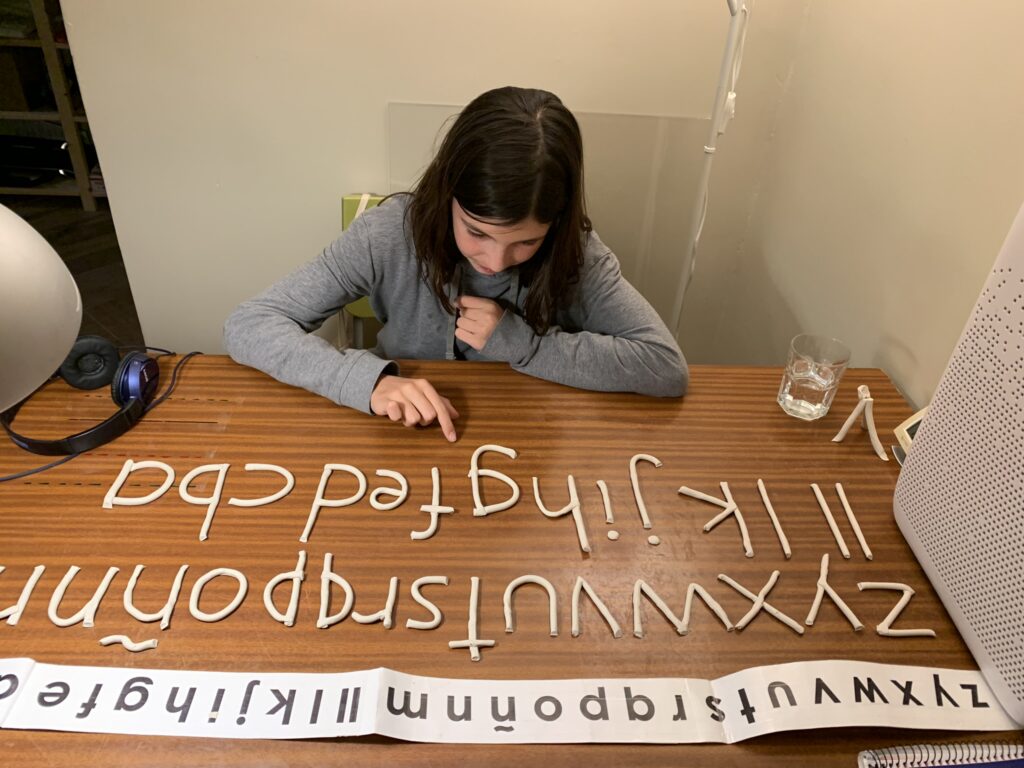
Buried in the replies was a comment from a parent who’d been where every other parent in that thread was sitting. Her daughter had struggled with sequencing, days of the week, months of the year. She’d done a Davis program. Eleven years later, her daughter had graduated college.
“Life would have been so different without the concepts she learned. I later trained to become a Davis Facilitator myself, because I was so blown away by the difference in her.”
That’s what happens when the right intervention addresses the underlying cause, not the symptom.
Your child not knowing the alphabet in 4th grade is not a character flaw, a parenting failure, or a sign of what their life will look like. It’s a signal that something specific isn’t being addressed. The right approach exists. It just doesn’t look like singing the song one more time.
If sequencing is a consistent pattern for your child — across the alphabet, days of the week, months of the year, it’s worth a conversation with a specialist who understands what’s driving it. Davis facilitators work with this directly. An initial conversation costs nothing.
Why can’t my child remember the alphabet even with daily practice?
The alphabet is an arbitrary sequence, there’s no logic to the order, just convention. For many dyslexic and ADHD or neurodivergent learners, repetition alone doesn’t anchor arbitrary sequences the way it does for neurotypical learners. More practice at the same approach produces more of the same result. The issue is the method of delivery.
Is forgetting the alphabet a sign of dyslexia?
It can be, particularly when it shows up alongside other sequencing difficulties like days of the week, months of the year, multi-step instructions, phone numbers. On its own it’s not diagnostic, but it’s a pattern worth discussing with a specialist who understands how dyslexic and ADHD and neurodivergent brains process ordered information.
What’s the difference between a memory problem and a sequencing problem?
Memory problems affect recall broadly. Sequencing problems are specific to ordered information with no inherent meaning, like the alphabet, timetables, or days of the week. A child can have an excellent memory for facts, stories, and spatial information, and still find arbitrary sequences genuinely difficult to hold. The two require different approaches.
My child knows all the letters but can’t put them in order. Is that normal?
Yes, and it’s an important distinction. Letter recognition and alphabet sequencing are separate skills. Many dyslexic learners know every letter by name and sound but struggle to produce the sequence reliably. This tells you the letters are there, the sequencing concept is what needs direct attention.