
If you’re an adult who struggles with reading, writing, or spelling, you may have dyslexia — and you’re far from alone. Around 10-15% of the population has dyslexia. Many adults reach midlife without ever getting a diagnosis, quietly compensating for difficulties they don’t fully understand.
That changes when you know what you’re working with.
Dyslexia isn’t just about reversing letters. As an adult, your experience might look like this:
These aren’t character flaws or laziness. They’re patterns that point to a different kind of brain — one with real strengths that conventional workplaces often overlook.
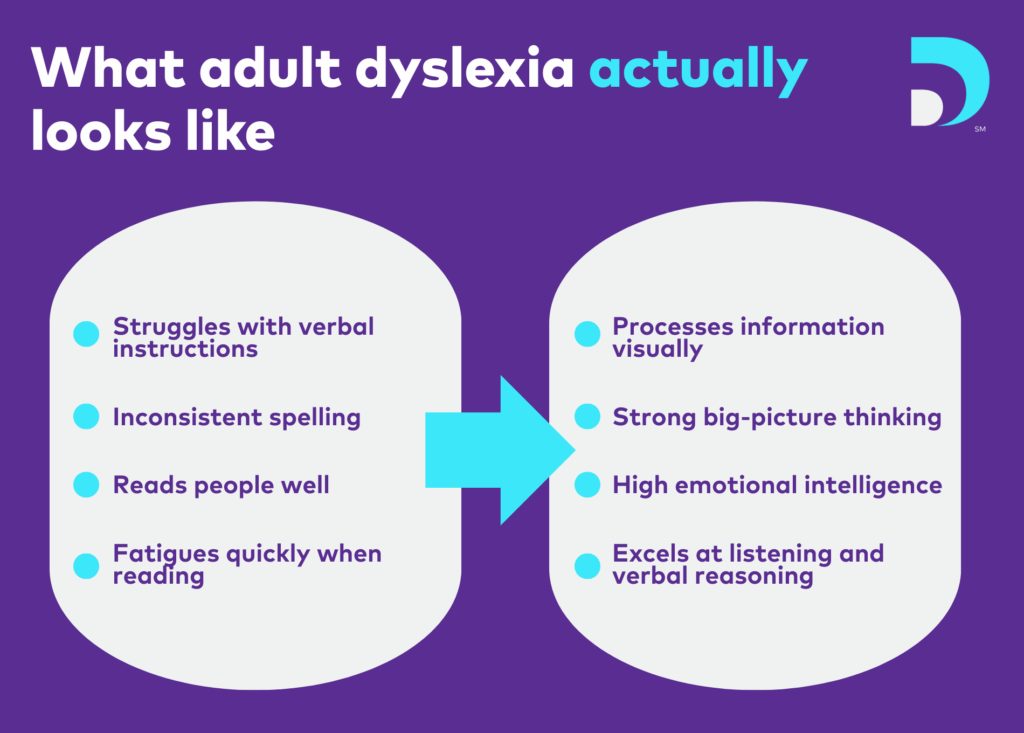
Dyslexic adults tend to be strong visual and spatial thinkers. You process information in pictures rather than words, which makes you better at seeing the big picture, connecting ideas, and solving problems creatively. These are the skills that drive innovation.
It’s no coincidence that people like Jamie Oliver, Richard Branson, Steven Spielberg, Keira Knightley, Zoe Saldaña, and Octavia Spencer have dyslexia. Branson has said his dyslexia gave him the ability to see the big picture in business — and in 2024 he launched a free learning platform, the University of Dyslexic Thinking, specifically to help others use those same strengths. Spielberg wasn’t diagnosed until his 60s; he described the discovery as “the last puzzle piece to a great mystery.” These aren’t people who succeeded despite dyslexia. Many credit it directly.
For younger generations, the conversation around dyslexia has shifted significantly. It’s increasingly framed as a different thinking style, not a deficit. But for many adults — especially those who struggled through school before dyslexia was well understood — the stigma runs deep. Low self-esteem, a fear of being “found out,” and years of compensating in silence are common.
That wasted potential isn’t inevitable. It’s the result of not having the right tools or support at the right time.
The Davis Method was developed by Ron Davis, an adult with dyslexia who found his own way through. The program works with your natural perceptual strengths rather than against them. It’s an intensive one-on-one programme — typically around 30 hours over one week — and follow-up work is done independently, at home, at no extra cost.
The Davis Method is effective for dyslexia and also for related learning differences including ADD/ADHD, dyspraxia, dyscalculia, and dysgraphia. It’s currently available in 38 countries and can be used in virtually any language.
If you’ve spent years managing around your difficulties rather than addressing them, this is a practical option worth knowing about.